
* All product/brand names, logos, and trademarks are property of their respective owners.
If you're new to purchasing components for a surface-mount assembly the feeder is among the first things you'll need to know about, and also one of the easiest to undervalue. It's small and mechanical and is often ignored in the wake of the costly SMT pick and place feeder it supports. However, it is silently deciding if your line is running at its full capacity or stops every few minutes because of missing picks and components that are thrown away.
Buyers who are new to the market tend to put their focus on the machine for placement and view feeders as an afterthought. Before you invest in or purchase a feeder, you should understand what a feeder does. This guide will explain the basics of what SMT feeders do working on, how they operate in pick-and-place equipment, and the most common types.
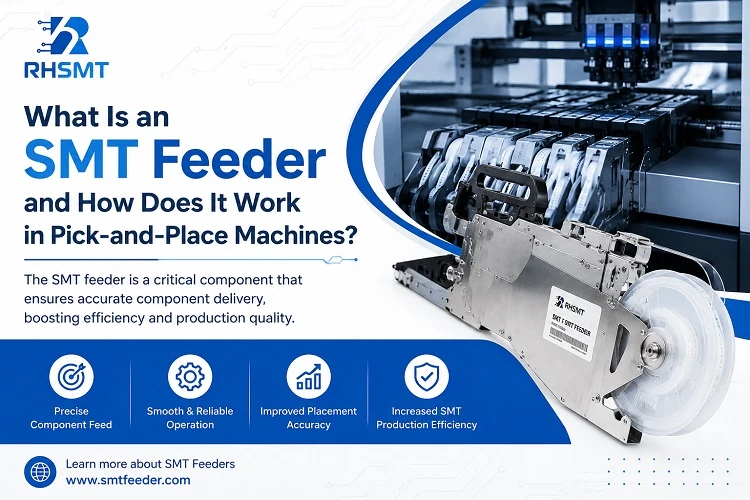
The SMT feeder is a mechanical instrument that is mechanical and holds electronic components and dispenses them in a sequence, to the machine's nozzle in a specific position. Surface-mount components are delivered by manufacturers packed on reels, in tubes, or in trays. The job of the feeder is to receive the packaging and bring every component to a specific pick-up point where the machine can take it and put it on the board.
Imagine the feeder as a loading mechanism that connects the raw components and the placing head. In the absence of it, an SMT pick and place feeder isn't able to reliably choose from. Each SMT mounter feeder is based on a single guarantee: the next part will always be located in the same place and in the same position, with the same level, and facing the same direction.
The feeder function is in the very beginning of the placement process. Here's the process in simple terms:
The vision of the pick-and-place machine's control system knows which part it requires next and which feeder is holding it. The machine's nozzle moves over the feeder slot that it has been assigned. The feeder has already moved the next component through the window for pickup. The nozzle is lowered, then applies vacuum, lifts the part and then carries it back onto the board.
The indexing process is the core component of the SMT pick and place feeder. It should be able to keep pace with the head that is placing it and be precise enough to ensure that the component is within the exact tolerances that the vision system is looking for.
This is why the reliability of your feeder matters more than the majority of new buyers think. The machine that places the order gets focus and attention, as does the price; however, the feeder function determines your actual throughput and the rate of failure.
While the designs can vary by maker and model, the majority of feeders are based on these components.
Holder for reels: This component holds the tape runs on a reel. The reel holder is mounted on this reel, allowing it to unwind easily as the component tapes are used up.
Track or Tape channel: A guided path that transports the tape off the reel towards the point of pickup, while keeping it in alignment so that components remain in the same place.
Peeling mechanism for the cover tape: SMT components sit in pockets on a tape that is sealed by an elongated cover tape at the top. Before pickup, the feeder peels this cover tape to expose the component. The tape that is peeling is removed or collected.
Indexing system: The drive that moves the tape one pocket at a time. In mechanical feeders, this is controlled through a sprocket and ratchet and on electric feeders, the motor is responsible for it, and has the ability to program it with precision.
Sprocket: An e-wheel that is inserted into the sprocket holes on the edges of the tape. Each turn pushes the tape forward using an incline that is set.
Window for picking up: The exposed opening in which the nozzle collects the component. This is the permanent location that the machine aims for.
Base and Interface for the feeder: It is the section that connects the feeder to the machine's feeder banks, and when it is a smart feeder connects electronically to the machine.
Different component packages need different feeders. Here are a few feeders to choose from.
The most popular kind. They are used to handle components on reels and tapes, including tiny 0201 resistors up to larger ICs. Tape feeders are available in standard sizes (8 mm, 12 mm, 16 mm, 24 mm, 44 mm, and beyond) to accommodate tape sizes. They are divided into two broad categories:
Mechanical tape feeders employ springs and ratchets to propel the tape. They're less expensive and do not require power; however, they require more manual setup and regular adjustments. Electronic or intelligent tape feeders use servo and stepper motors and are often in communication with the device.
These handle components that are shipped through plastic tubing, which typically include ICs as well as connectors. Vibration or gravity pushes parts along the tube to a pick-up point. They are suitable for smaller-volume or special components that aren't available on tape.
Large ICs and other fine-pitch components typically are shipped in a matrix tray (JEDEC tray). Tray feeders feed these trays to the machine, often with automated tray changers that can swap empty trays with full ones, without stopping the process.
Bulk feeders are used to handle loose parts that are fed through a hopper. They are ideal for simple components with a high consumption. Radial feeders are used to feed certain through-hole parts in special lines.
If you are a buyer who is unfamiliar with purchasing, it's tempting to think of feeders as a secondary consideration to the pick-and-place machine. This is a costly error.
Feeders are consumable capital. You'll need enough to cover all the components on your most popular board, as well as spares to changeover and maintenance. A single line could be a huge undertaking and require hundreds or dozens of feeders. The cost of all the feeders can be as high as an important portion of the machine.
The condition of the SMT mounter feeder also affects your success rate. Broken sprockets, sticky peeling mechanisms, and drifting accuracy of indexes show up as thrown parts and line stoppages.
Feeder compatibility locks you into a specific system. Feeders are usually designed to work with specific machines with feeder banks as interfaces. Before purchasing, make sure that the feeder you are purchasing is compatible with your machine's model, make, and specifications for mounting.
A quick checklist for buyers who are first time buyers:
Verify compatibility of the machine by make and model. Find the feeder width that matches the dimensions of your tape components. Choose between electric and mechanical according to your volume and precision requirements. Take into consideration whether advanced features such as component counting are worth the cost for your business. Take into account the quantity you require, including spares. Find replacement parts as well as service support.
Being able to identify these when you are sourcing them will save you from costly mismatches as well as delay later.
An SMT feeder might only be a small component of your production line; however its function is not merely minor. It acts as an intermediary between the components packaged and the placement head, and its speed, accuracy, and reliability determine the quality of your production and defect rate.
If you need tube feeders, tape feeders or SMT mounter feeders to fit your production line, our team at SMT Feeders will help to match the correct feeder for your machine and your production objectives. Explore our selection of SMT feeders, or call our experts now for advice specific to your needs.

I’m a positive and ambitious person who enjoys learning new things, meeting people, and growing through every experience. I value honesty, confidence, and keeping a balanced outlook in life.
The industrial diesel engine is commonly found in construction equipment, generators, agricultural e
18 August 2026
Workplace safety has come a long way over the past few decades, and one area that has seen major imp
18 August 2026
When you walk into any major concert event today, the first thing that hits you is the visuals. You
11 August 2026
Be the first to share your thoughts
No comments yet. Be the first to comment!
Share your thoughts and join the discussion below.
.webp&w=3840&q=75)




.webp&w=3840&q=75)
.webp&w=3840&q=75)

.webp&w=3840&q=75)
.webp&w=3840&q=75)