
* All product/brand names, logos, and trademarks are property of their respective owners.
Engineering and fabrication across the UK are constantly evolving as manufacturers look for materials that are lighter, stronger, and more cost-effective than traditional metals. In this shift, plastic rods have become a versatile go-to solution, offering the performance engineers need without some of the drawbacks of metal.
From CNC workshops producing precision components to large-scale industrial facilities working in chemically demanding environments, these engineering-grade plastics are now selected for their practical performance rather than convenience alone. Modern polymers bring a balance of mechanical strength, corrosion resistance, low friction, and thermal stability — all while reducing the overall weight of systems. This makes them ideal for applications where efficiency, durability, and precision are equally important.
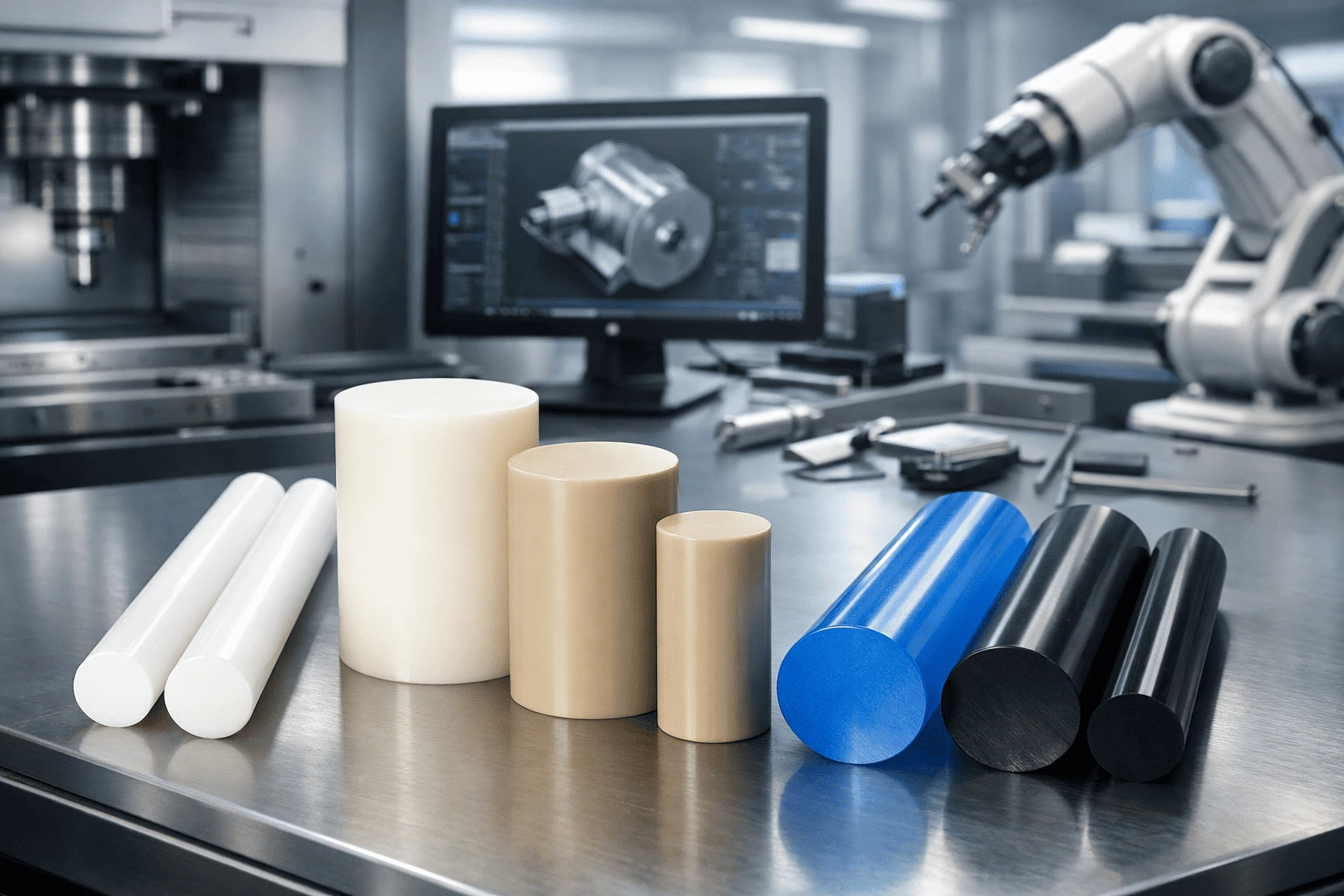
Materials like Acetal, Nylon, UHMWPE, Polypropylene, PTFE, PEEK, HDPE, PET, PVC, Tufnol, Oilon, and Polyurethane each bring their own unique strengths to the table. Some are perfect for compact, high-precision components, while others excel as heavy-duty structural elements. The wide variety of options allows engineers to match each material’s properties to the specific demands of their projects, whether that’s machining intricate parts, handling chemical exposure, or supporting heavy loads. In the sections that follow, we’ll explore the main benefits of plastic rods in engineering and fabrication, look at how different materials meet specific industrial needs, and share practical guidance for selecting the right solution for any application.
One of the primary reasons plastic rods are increasingly specified in UK engineering projects is their exceptional strength-to-weight ratio. Many engineering plastics provide high mechanical performance without the associated mass of metals such as steel or aluminium.
For example, Nylon and PEEK rods are often used in structural and load-bearing applications where resilience is essential but reducing component weight is equally critical. Even smaller profiles like Acetal provide impressive rigidity and dimensional stability in machined components. Reducing component weight while maintaining durability contributes to improved energy efficiency, easier installation, and lower operational stress on machinery.
Unlike metals, most engineering plastics resist rust and corrosion, making them ideal for moisture- or chemical-prone environments. Polypropylene, PTFE, HDPE, and PVC rods are frequently specified in processing systems due to their chemical and moisture resistance.
In water treatment facilities, food manufacturing plants, and chemical processing systems, corrosion resistance extends service life and reduces maintenance cycles, helping maintain consistent performance across demanding industrial applications.
Friction and wear present ongoing challenges in mechanical systems. Certain plastics, such as self-lubricating nylon or UHMWPE, offer naturally low friction coefficients, reducing wear and minimizing lubrication requirements. Flexible polyurethane rods also perform well in impact-prone applications, providing resilience without sacrificing strength.
These properties make plastic rods suitable for moving assemblies, rollers, bushings, and fabricated mechanical parts across diverse industrial sectors.
Material selection requires careful assessment of operational demands, including load, environmental factors, machining accuracy, and insulation. Engineers often rely on Plastic Rods as a practical solution, offering adaptability and performance across various industrial applications. Their properties suit both precision components and heavy-duty structures, which is why examining the full range of available rods is important to ensure the chosen material meets project-specific requirements.
For CNC machining and precision fabrication, dimensional stability is crucial. Acetal and PET rods are frequently used for intricate components due to low moisture absorption and excellent machinability. High-performance polymers like PEEK maintain strength and thermal stability, ensuring precision under demanding conditions. Using materials with predictable machining characteristics reduces waste, improves efficiency, and enables consistent production quality across multiple runs.
Certain industrial applications require materials capable of withstanding substantial mechanical stress. UHMWPE and Tufnol rods offer impact resistance and durability, while Nylon and polyurethane rods are used for assemblies requiring toughness and shock absorption.
Matching materials to load conditions ensures reliability and prolongs operational lifespan in demanding industrial environments.
Plastic rods are often selected for their non-conductive and heat-resistant properties. PTFE and PVC rods are widely used in insulating components and enclosures. PEEK and PET rods support high-temperature applications where both mechanical performance and electrical insulation are required. These characteristics make plastic rods suitable for components where electrical safety and thermal stability are critical considerations.
Plastic rods are integrated into a wide range of industrial systems, from precision fabrication to large-scale structural builds.
Machinability and consistency make plastic rods ideal in CNC environments. Acetal and Nylon rods are commonly used in gears, spacers, and custom-machined components. Smaller profiles like PVC and PTFE enable detailed fabrication work, reducing tool wear while maintaining high-quality finishes.
Hygiene and chemical resistance are vital in processing industries. Polypropylene and HDPE rods support fluid-handling systems, while UHMWPE and PTFE rods perform well in high-wear or chemically aggressive environments, maintaining system integrity across demanding operational conditions.
High-performance plastics such as PEEK are used in automotive and advanced engineering sectors, where strength and thermal resistance are essential. Low-friction Oilon rods provide reliable support in moving assemblies, while Tufnol and Nylon rods offer insulation and structural support for heavy-duty fabrication projects.
Availability in varied diameters enhances design flexibility. Small-diameter rods suit precision components, mid-range options balance strength with machinability, and larger diameters provide heavy-duty structural support. Access to a broad range of sizes allows engineers to align material choice precisely with mechanical and structural requirements.
Plastic rods have become integral to engineering and fabrication because they combine strength, weight reduction, corrosion resistance, and machinability. Modern polymers offer performance-driven advantages tailored to specific industrial needs, rather than simply replacing metal components.
From precision-machined Acetal parts to heavy-duty UHMWPE structures and chemically resistant Polypropylene systems, engineers can select materials based on measurable performance criteria. Considering load requirements, environmental conditions, thermal exposure, and machining tolerances ensures consistent and efficient manufacturing outcomes. For those exploring material options for future projects, reviewing the broader engineering plastics range available at PrimePlasts.uk provides additional technical context and specification guidance.

A tech and business writer who enjoys exploring how innovation, automation, and smart design shape modern industries. Focused on creating informative, easy-to-read content that delivers real value to readers.
The industrial diesel engine is commonly found in construction equipment, generators, agricultural e
18 August 2026
Workplace safety has come a long way over the past few decades, and one area that has seen major imp
18 August 2026
When you walk into any major concert event today, the first thing that hits you is the visuals. You
11 August 2026
Be the first to share your thoughts
No comments yet. Be the first to comment!
Share your thoughts and join the discussion below.

.webp&w=3840&q=75)








.webp&w=3840&q=75)
.webp&w=3840&q=75)