
* All product/brand names, logos, and trademarks are property of their respective owners.
For many people, a swimming pool or beach is a place to relax and enjoy time with family and friends. For a lifeguard, however, it is a place where focus, preparation, and quick decision-making can save lives. That is why enrolling in a professional lifeguard class is one of the most important steps toward building strong aquatic safety skills.
Today, people commonly search online for:
A lifeguard class teaches students how to prevent emergencies, perform water rescues, administer CPR and first aid, and maintain safe aquatic environments. These classes combine physical training, emergency response practice, teamwork, and leadership development.
Unlike ordinary swimming lessons, lifeguard classes focus on real-life rescue situations and professional responsibility. Students are trained to stay calm under pressure while responding quickly during emergencies.
This guide explains what students experience during a lifeguard class, the skills they develop, and why professional certification is essential for anyone pursuing a career in aquatic safety.
Before joining a lifeguard class, students usually must complete certain prerequisites to prove they are physically prepared for training.
Most programs require participants to:
These tests help instructors confirm that students can safely participate in rescue training.
Lifeguards may need to:
Strong endurance helps lifeguards remain effective during stressful situations.
Organizations such as the American Red Cross and American Lifeguard Association include physical evaluations as part of their professional training standards.
Lifeguard classes are not only physical, but students also learn the theory behind aquatic safety and emergency response.
Classroom instruction commonly includes:
Understanding these concepts helps students make safer and faster decisions during emergencies.
Professional lifeguards focus heavily on accident prevention.
Students learn how to:
Preventing emergencies is often more effective than responding after accidents occur.
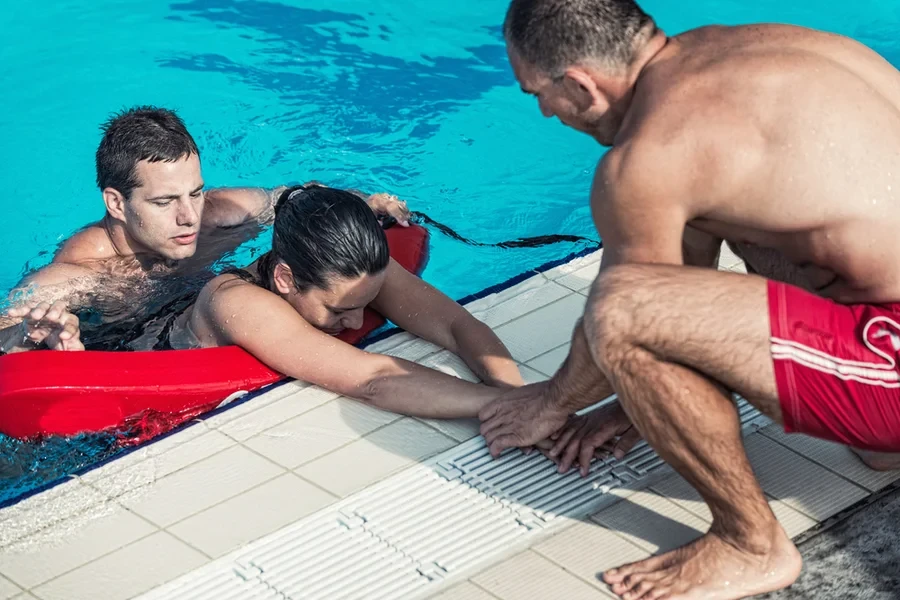
Water rescue training is one of the most important parts of a lifeguard class.
Students learn how to help swimmers without entering the water whenever possible.
Common rescue equipment includes:
Throwing assists involve using flotation equipment to support distressed swimmers from a safe distance.
Training focuses on:
Active victims are conscious swimmers struggling in the water.
Students practice:
Passive victims may be unconscious or unable to move independently.
Training includes:
Hands-on rescue practice prepares students for real emergencies.
Lifeguards are often the first responders during medical emergencies.
Students learn CPR procedures for:
Training includes:
Repeated practice helps students respond confidently under pressure.
AED stands for Automated External Defibrillator.
Students learn:
Fast CPR and AED use can significantly improve survival rates during cardiac emergencies.
Lifeguard classes teach treatment for:
These first aid skills are valuable both inside and outside aquatic environments.
One of the biggest responsibilities of a lifeguard is continuous observation.
Surveillance means constantly scanning swimmers and identifying danger quickly.
Students learn how to:
Strong surveillance skills help lifeguards prevent emergencies before rescues become necessary.
Lifeguards are trained to identify:
Recognizing hazards early helps maintain safer aquatic environments.
Most aquatic emergencies involve multiple rescuers working together.
Students participate in:
Strong teamwork improves rescue speed and efficiency.
Lifeguards use:
Clear communication reduces confusion during stressful situations.
Lifeguarding requires strong mental focus and emotional control.
During emergencies, lifeguards must:
Scenario-based training helps students improve confidence and critical thinking abilities.
Certified lifeguards are trusted to protect lives. Professional training helps students develop:
These qualities are valuable in many careers beyond lifeguarding.
Completing a lifeguard class creates opportunities in many aquatic environments.
Pool lifeguards commonly work at:
Waterfront lifeguards supervise:
Additional open-water training may be required.
Surf lifeguards work in ocean environments where conditions constantly change.
Training may include:
Surf lifeguarding is physically demanding and highly specialized.
Professional lifeguard training offers both personal and career benefits.
Certified lifeguards may enjoy:
Searches for lifeguard jobs near me and summer lifeguard positions continue to increase every year.
Lifeguard classes help students build:
These transferable skills are valuable in many professions.
Lifeguards help protect families, children, and communities while creating safer aquatic environments.
Few jobs provide such direct opportunities to save lives.
A professional lifeguard class prepares students to prevent accidents, perform rescues, and respond confidently during emergencies. Through water rescue training, CPR certification, first aid education, surveillance practice, and teamwork exercises, lifeguards develop the skills needed to protect lives in aquatic environments.
Whether you are searching for a lifeguard class near you, how to become a lifeguard, or the best lifeguard certification program, professional training is the first step toward a meaningful and respected career in aquatic safety.
Lifeguarding is more than a job it is a commitment to responsibility, leadership, teamwork, and life-saving service.

Evan Richardson is a certified Aquatic Safety Instructor and experienced lifeguard trainer with over 15 years of experience in water rescue operations, CPR education, and aquatic facility management. He has trained lifeguards across pools, waterfront programs, and recreation centers while promoting professional rescue standards and community water safety awareness.
At a Glance
3 October 2026
Studying abroad can be an important step toward building an international career. With access to qua
8 September 2026
Technology is becoming an important part of modern education. Students interact with AI, coding plat
25 August 2026
Be the first to share your thoughts
No comments yet. Be the first to comment!
Share your thoughts and join the discussion below.
.webp&w=3840&q=75)






.webp&w=3840&q=75)
.webp&w=3840&q=75)


.webp&w=3840&q=75)