
* All product/brand names, logos, and trademarks are property of their respective owners.
Technology is becoming an important part of modern education. Students interact with AI, coding platforms, robotics, smart devices, and digital systems from an early age. A Tech Olympiad gives students a structured opportunity to understand technology, solve challenges, and demonstrate their skills.
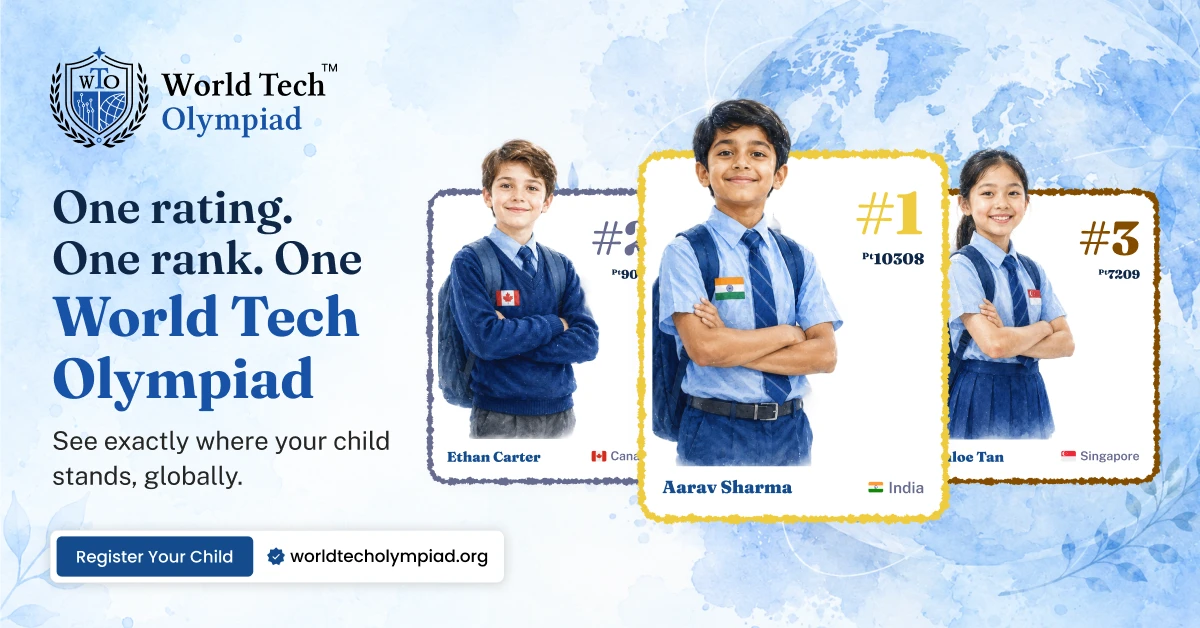
The World Tech Olympiad provides a global technology competition for students from Class 2 to Class 12. It brings together areas such as Artificial Intelligence, coding, robotics, cybersecurity, computational thinking, mathematics, and logical reasoning.
A Tech Olympiad is a competition focused on technology knowledge and practical thinking. It encourages students to understand how technology works and apply their knowledge to solve problems.
Students may explore:
The goal is not simply to memorize information but to analyze situations, identify patterns, think logically, and develop solutions.
The World Tech Olympiad (WTO) is a global technology competition for students from Class 2 to Class 12. Students can explore AI, coding, cybersecurity, robotics, and computational thinking according to their learning level.
WTO uses three class-based tracks:
Younger students can explore visual and block-based coding, logic, sequencing, introductory AI concepts, and digital safety.
Students can move toward Python fundamentals, computational thinking, AI and data concepts, and cybersecurity awareness.
Older students can explore applied AI and machine learning, cybersecurity, robotics, algorithms, and technology projects.
This structure allows students to learn at a level appropriate for their class and experience.
Students can explore age-appropriate concepts related to intelligent systems, AI applications, data, and machine learning.
Programming teaches students how to create instructions for computers while developing understanding of sequences, conditions, algorithms, patterns, and structured problem-solving.
Robotics connects programming with physical machines. Students can learn how instructions, sensors, automation, and programmed logic help robots perform tasks.
Students can develop awareness of passwords, privacy, phishing, safe browsing, personal data, and common online risks.
Computational thinking helps students break complex problems into smaller parts, identify patterns, organize information, and create logical solutions.
A Tech Olympiad makes technology learning more active and engaging. Students apply their knowledge to solve challenges instead of only learning concepts.
Technology challenges encourage students to understand problems and find suitable solutions.
Coding, algorithms, puzzles, and computational challenges help students develop structured thinking.
Successfully solving challenges can improve students' confidence in working with technology.
Technology competitions can motivate students to explore new concepts and learn beyond their regular syllabus.
WTO provides skill ratings and rankings that allow students to track their progress and compare their performance globally.
Students can receive certificates and recognition based on their participation and achievements. WTO also provides verifiable certificates with unique IDs.
Students do not need advanced technical knowledge to begin. Younger learners can explore:
As they grow, students can progress toward Python, algorithms, AI, cybersecurity, robotics, and technology projects.
Parents can enroll their children directly in the World Tech Olympiad. Parents can encourage children interested in coding, AI, robotics, computers, cybersecurity, STEM activities, logic, and technology innovation.
Parents do not need technical expertise. Their role can focus on encouraging regular practice, curiosity, and a healthy approach to competition.
Schools can participate in the World Tech Olympiad and provide students with technology-based competition opportunities.
Schools can use a Tech Olympiad to encourage:
Teachers can also support preparation through coding exercises, logic puzzles, AI discussions, cybersecurity activities, and robotics projects.
Technology education can prepare students for future learning across multiple fields. Coding can provide a foundation for software development and AI, computational thinking can support data science and engineering, robotics can introduce automation, and cybersecurity can lead toward digital security and information technology.
A technology competition can therefore help students discover their interests at an early stage.
Students do not need to memorize large amounts of information. They should focus on understanding concepts and practicing different types of problems.
Understand fundamental concepts appropriate for the student's class.
Puzzles, patterns, sequences, and reasoning exercises can improve structured thinking.
Practice programming concepts through small exercises and simple projects.
Exploring how AI, robots, search systems, and digital tools work can make technology concepts easier to understand.
Review incorrect answers and understand why an approach did not work.
Short and regular practice sessions can help students build stronger skills.
Traditional Olympiads usually focus on academic subjects such as Mathematics, Science, and Languages. A Tech Olympiad focuses more on modern technology skills, including Artificial Intelligence, coding, robotics, cybersecurity, and computational thinking.
Both types of competitions can complement each other. Traditional Olympiads can strengthen academic foundations, while Tech Olympiads provide exposure to future-focused technology and digital skills.
A Tech Olympiad can become the starting point for a longer learning journey.
Students interested in emerging technologies can explore specialized education through Blockchain Council, which provides courses and certifications in blockchain, Web3, cryptocurrency, and related technologies.
Global Tech Council offers technology-focused learning and certifications in areas such as AI, programming, data science, and emerging technologies.
Students interested in technology combined with business, marketing, or management can explore professional programs through Universal Business Council.
The value of a technology competition is not limited to winning. Students gain experience by preparing, attempting challenges, reviewing results, and improving their skills.
The World Tech Olympiad combines learning, practice, competition, and recognition. Students can build a persistent skill rating and global ranking rather than relying only on one examination score. Its online format also allows students to participate remotely.
A Tech Olympiad can suit students who:
Students do not need advanced knowledge before participating. The class-based structure allows them to develop their skills according to their learning level.
A Tech Olympiad gives students a different way to experience technology. Instead of only using technology, students get an opportunity to understand it, solve problems with it, and explore how it works.
The World Tech Olympiad brings AI, coding, robotics, cybersecurity, and computational thinking together in a global competition for students from Class 2 to Class 12.
For parents, it provides a structured way to introduce children to future-ready technology skills. For schools, it can support STEM and technology initiatives while encouraging students to keep learning and exploring.
A Tech Olympiad is a technology-focused competition where students solve challenges related to AI, coding, robotics, cybersecurity, and computational thinking.
The World Tech Olympiad (WTO) is a global technology competition for students from Class 2 to Class 12 with age-based learning tracks.
Students may explore Artificial Intelligence, coding, robotics, cybersecurity, computational thinking, mathematics, logical reasoning, and digital technology.
WTO is designed for students from Class 2 to Class 12 through Foundation, Explorer, and Innovator tracks.
No. Students can participate according to their class and learning level, with concepts introduced progressively.

No bio available yet.
At a Glance
3 October 2026
Studying abroad can be an important step toward building an international career. With access to qua
8 September 2026
Imagine walking into a high-stakes corporate steering committee meeting. You’ve spent the last
3 July 2026
Be the first to share your thoughts
No comments yet. Be the first to comment!
Share your thoughts and join the discussion below.
.webp&w=3840&q=75)






.webp&w=3840&q=75)
.webp&w=3840&q=75)


.webp&w=3840&q=75)