
* All product/brand names, logos, and trademarks are property of their respective owners.
Busy industrial spaces put floors to the test every day. Warehouses, factories, workshops, and even busy entrances face constant foot traffic, moving equipment, moisture, and dirt. Over time, this wear and tear can increase slip hazards, damage flooring, and cause physical strain for workers. Rubber matting offers a practical solution, improving stability, easing fatigue in standing areas, and protecting underlying surfaces. It’s not just a floor covering—it enhances safety, durability, and efficiency all at once. In environments where productivity and safety must coexist, understanding the right matting for each area is key to smarter, long-lasting workplace solutions
Slips and trips remain one of the most common causes of workplace accidents in industrial environments. High footfall areas, especially those exposed to moisture or dust, require surfaces that maintain grip under changing conditions. Rubber matting provides consistent traction that helps stabilise movement throughout the working day.
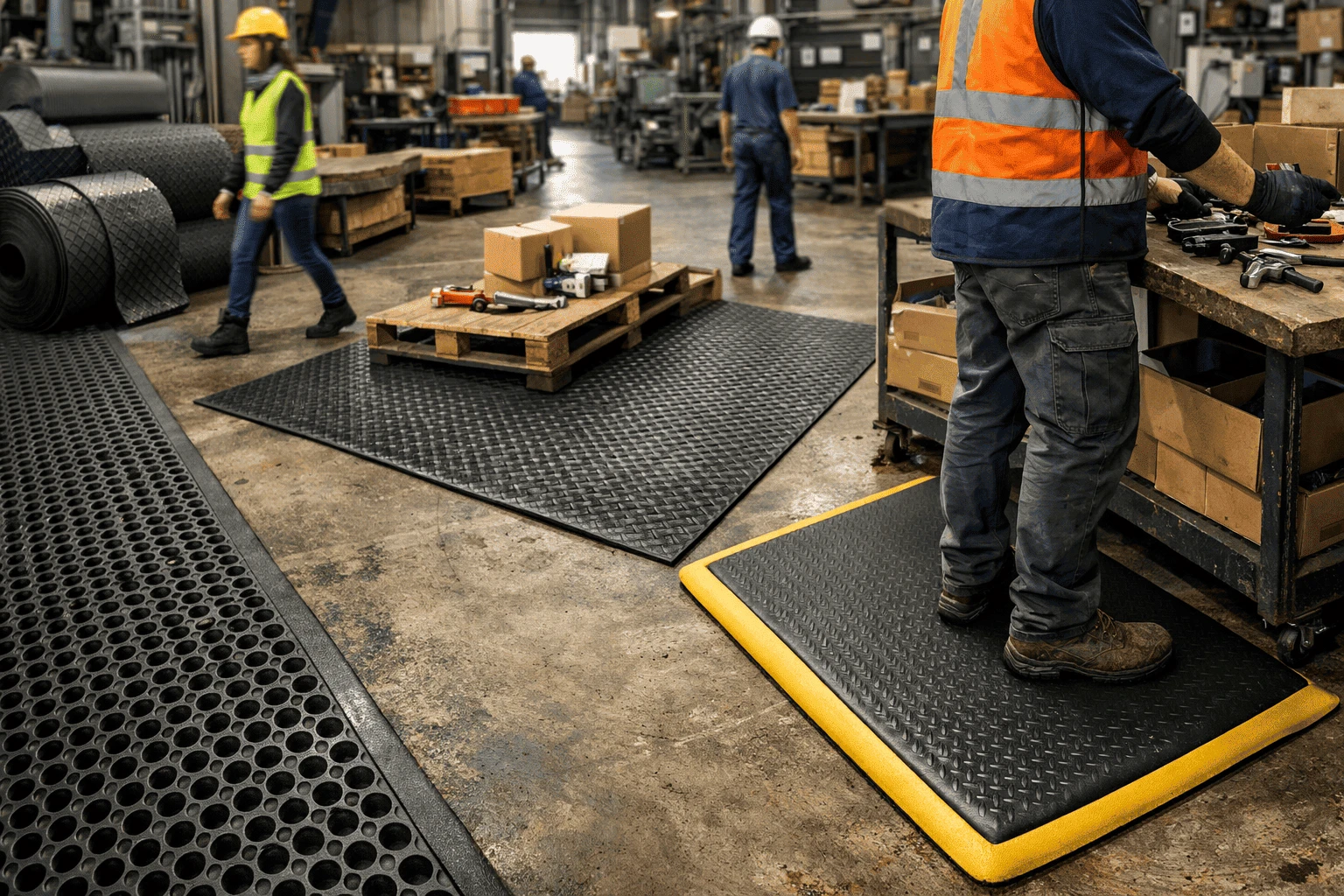
Textured surfaces play a key role here. Patterns such as diamond or honeycomb increase surface contact underfoot, improving grip without restricting movement. Anti-slip mats with these textures are often used in shared walkways and active work zones where stability is critical but flexibility is still required. By improving underfoot confidence, rubber matting helps reduce sudden slips and missteps, supporting safer movement in busy environments where distractions and pace are part of daily operations.
Moisture and debris significantly increase floor risk, particularly in industrial settings where materials are constantly being moved in and out. Rubber matting helps manage these hazards by trapping dirt and allowing water to disperse, keeping surrounding floor areas safer and easier to maintain.
Entrance-focused designs, such as honeycomb-patterned entrance mats, are commonly used to intercept contaminants before they spread further inside. Open structures allow debris to fall away from the walking surface, reducing the likelihood of slips while also protecting internal floors from abrasion caused by grit. By controlling these everyday hazards, rubber matting contributes to safer working conditions while reducing the cleaning and maintenance burden associated with high-traffic industrial floors.
Many industrial roles involve prolonged standing at workstations, packing lines, or inspection points. Standing on hard floors for extended periods can lead to muscle fatigue, joint discomfort, and reduced concentration, all of which may impact productivity and well-being.
Anti-fatigue rubber matting is designed to reduce this strain by providing controlled cushioning underfoot. Some mats encourage subtle foot movement, helping improve circulation while reducing pressure on the lower body. This type of surface supports workers without feeling unstable, which is important in task-focused environments. Over time, the use of anti-fatigue matting can contribute to improved comfort and reduced physical stress, particularly in areas where employees remain in one position for much of their shift.
Comfort must always be balanced with safety in industrial settings. Anti-fatigue mats that also offer reliable grip ensure workers remain supported without increasing the risk of slips. Mats that combine cushioning properties with textured surfaces are suitable for standing areas where stability is as important as comfort, such as production floors or workbenches exposed to regular movement.
By integrating fatigue relief with slip resistance, this type of matting supports safer working practices while helping reduce long-term physical strain on employees.
High-traffic areas place continuous stress on floor coverings. Mats used in these zones must resist wear while maintaining their functional properties over time. Heavy-duty rubber matting is designed to meet these demands without curling, cracking, or losing grip.
Products within the rubber matting category are typically engineered to handle heavy use while offering dependable performance across a range of industrial environments, making them suitable for areas where flooring is exposed to continuous activity. Textured designs help maintain traction, while the rubber construction absorbs some impact from constant movement, supporting both worker stability and floor longevity.
In warehouses, corridors, and production spaces, covering larger areas efficiently is often a priority. Rubber matting rolls offer a practical solution by providing consistent protection across wide surfaces. Dotted or textured rolls improve traction, while the thickness provides a protective layer that helps shield floors from ongoing wear. Loose-lay installation allows these rolls to be adapted to changing layouts, making them particularly useful in environments where flexibility is important.
Entrances are among the most challenging areas to manage, especially in the UK’s wet climate. Rain, dirt, and debris can quickly create slippery conditions if not properly controlled. Honeycomb-patterned entrance mats allow moisture and dirt to fall through their structure, keeping the walking surface clearer and safer. This reduces slip risks at the point of entry and limits the spread of contaminants further inside the building. Effective entrance matting plays a crucial role in maintaining safety while also protecting internal flooring from premature wear.
Floor transitions can introduce trip risks when surfaces change height or texture. Ramped matting solutions help smooth these changes, supporting safer movement for both pedestrians and wheeled equipment.
Mats with gently tapered edges reduce abrupt changes in surface height that may otherwise catch footwear or trolley wheels. Loose-lay designs also allow repositioning, making them suitable for temporary or evolving layouts. By addressing these transition points, rubber matting supports safer navigation across busy industrial spaces.
Selecting suitable rubber matting starts with understanding how each area is used. Standing zones, walkways, entrances, and transition points all present different challenges. Factors such as moisture exposure, footfall volume, and duration of use should guide selection. Matching mat characteristics to these conditions ensures the matting performs as intended without unnecessary compromise.
Key considerations include slip resistance, comfort, durability, thickness, and ease of maintenance. Loose-lay designs offer flexibility, while textured surfaces improve safety in demanding environments. Taking a measured approach to selection helps ensure rubber matting delivers long-term value rather than serving as a short-term fix.
Understanding the specific demands of each area — whether entrances, high-traffic walkways, or static workstations — is essential to choosing the right solution. Rather than relying on a single approach, effective matting strategies consider how people move, stand, and work throughout the space. By focusing on function, environment, and long-term performance, industrial facilities can create safer and more resilient working conditions. Additional resources and examples of industrial matting solutions can be found at therubbermats.uk, guiding selecting the right mat for different areas.

UK writer Evan covers home improvement, construction, and lifestyle trends, sharing practical insights for readers.
If you’ve been working in Health & Safety for a while, you’ve probably attended ISO
25 March 2026
The digital revolution has reshaped how organizations operate, communicate, and grow. Traditional wo
24 March 2026
Engineering and fabrication across the UK are constantly evolving as manufacturers look for material
13 February 2026
Be the first to share your thoughts
No comments yet. Be the first to comment!
Share your thoughts and join the discussion below.








.webp&w=3840&q=75)


.webp&w=3840&q=75)