
* All product/brand names, logos, and trademarks are property of their respective owners.
Canada is known for its welcoming immigration policies and strong commitment to family reunification. One of the most popular pathways for unmarried couples to build a life together in Canada is through Common Law Sponsorship Canada. This immigration program allows Canadian citizens and permanent residents to sponsor their common-law partners for permanent residency, helping families stay together and establish a secure future.
If you and your partner are considering this route, understanding the eligibility requirements, application process, documentation, and common challenges can significantly improve your chances of success. This comprehensive guide covers everything couples need to know about common-law sponsorship in Canada.
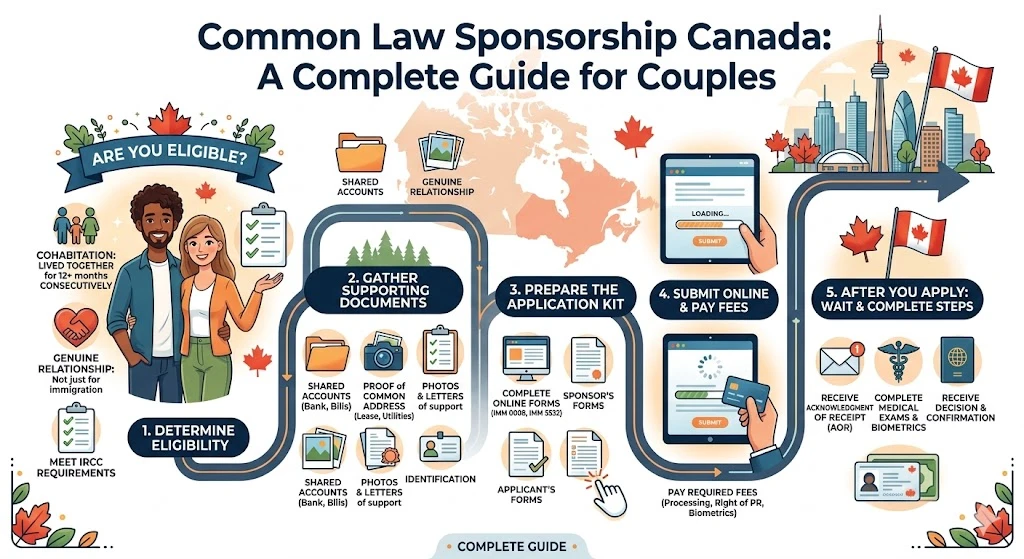
Common-law sponsorship is part of Canada's Family Class immigration program. It enables Canadian citizens and permanent residents to sponsor a partner with whom they have lived in a marriage-like relationship for at least 12 consecutive months.
Unlike married couples, common-law partners are not required to have a marriage certificate. However, they must prove that their relationship is genuine and that they have continuously cohabited for the required period.
The Canadian government recognizes common-law relationships as legally valid partnerships when sufficient evidence demonstrates a committed and exclusive relationship.
According to Canadian immigration regulations, a common-law partner is someone who has lived with their partner continuously for at least one year in a conjugal relationship.
To qualify, couples must demonstrate:
Temporary separations due to work, travel, family emergencies, or other unavoidable circumstances may be acceptable if the couple can prove they maintained their relationship during those periods.
Not everyone can sponsor a common-law partner. The sponsor must meet specific eligibility criteria established by Immigration, Refugees and Citizenship Canada (IRCC).
A sponsor must:
Sponsors must also sign an undertaking agreeing to support their partner financially for a specified period after permanent residence is granted.
The sponsored common-law partner must also meet certain requirements.
They must:
Applicants may be found inadmissible due to criminal convictions, security concerns, medical issues, or misrepresentation.
One of the most important aspects of a successful application is proving the existence of a genuine common-law relationship.
IRCC carefully evaluates evidence to determine whether the relationship is authentic and not entered into solely for immigration purposes.
Useful evidence includes:
Letters from family members, friends, colleagues, or community leaders can provide additional proof that the relationship is genuine and well-established.
Couples applying through common-law sponsorship generally choose between two application streams.
Inland sponsorship is for couples living together in Canada.
Benefits include:
However, international travel may be more complicated while the application is in progress.
Outland sponsorship is typically used when the sponsored partner lives outside Canada.
Advantages include:
Choosing the right pathway depends on the couple's individual circumstances and long-term plans.
Understanding the application process helps reduce mistakes and delays.
Begin by collecting all required forms and supporting evidence. Missing documents can result in processing delays or refusals.
Both the sponsor and applicant must complete multiple forms accurately and honestly.
Double-check all information before submission.
Applicants must pay applicable fees, including:
Applications can generally be submitted online through the designated immigration portal.
Ensure all supporting documents are uploaded correctly.
The applicant may receive instructions to provide fingerprints and photographs and complete a medical examination with an approved physician.
IRCC conducts criminal, security, and eligibility assessments.
Additional information may be requested during this stage.
Once approved, the sponsored partner receives confirmation of permanent residence and can begin their new life in Canada.
While many applications are approved, some are refused due to avoidable issues.
Common reasons include:
A lack of convincing documentation can raise concerns about the authenticity of the relationship.
Conflicting answers on forms, interviews, or supporting documents may create credibility issues.
Applicants who cannot prove 12 consecutive months of living together may not qualify as common-law partners.
Providing false information or omitting important details can result in refusal and future immigration consequences.
Certain criminal records or serious health conditions may affect eligibility.
Preparing a well-documented application significantly improves approval chances.
Consider these best practices:
Quality documentation often makes the difference between approval and refusal.
Processing times vary based on application type, workload, country of residence, and case complexity.
Several factors can influence timelines:
Applicants should regularly check official processing updates and ensure their contact information remains current.
In many cases, applicants under inland sponsorship may qualify for an open work permit while their permanent residence application is being processed.
This can provide several benefits:
Eligibility requirements should be reviewed carefully before applying.
Once permanent residence is granted, sponsored partners enjoy many of the same rights as other permanent residents.
These include:
Sponsors remain financially responsible for the sponsored partner during the sponsorship undertaking period, even if the relationship later ends.
Common-law sponsorship provides a valuable opportunity for couples to build their future together in Canada without being legally married. While the process can seem complex, careful preparation, accurate documentation, and a thorough understanding of the requirements can greatly improve the likelihood of success.
By proving a genuine relationship, meeting eligibility standards, and submitting a complete application, couples can take an important step toward permanent residency and long-term stability in Canada. Whether you are just beginning your journey or preparing your application package, understanding the fundamentals of common-law sponsorship can help you navigate the process with confidence and clarity.

At a Glance
3 October 2026
Studying abroad can be an important step toward building an international career. With access to qua
8 September 2026
Technology is becoming an important part of modern education. Students interact with AI, coding plat
25 August 2026
Be the first to share your thoughts
No comments yet. Be the first to comment!
Share your thoughts and join the discussion below.
.webp&w=3840&q=75)





.webp&w=3840&q=75)
.webp&w=3840&q=75)


.webp&w=3840&q=75)