
* All product/brand names, logos, and trademarks are property of their respective owners.
For years, Amazon SEO had a fairly clear shape. A shopper typed a keyword, Amazon ranked results using relevance and performance signals, and your job was to be relevant, convert well, and stay in stock. All of that still matters. But another layer now sits between the shopper and your product detail page: Rufus, Amazon's generative AI shopping assistant.
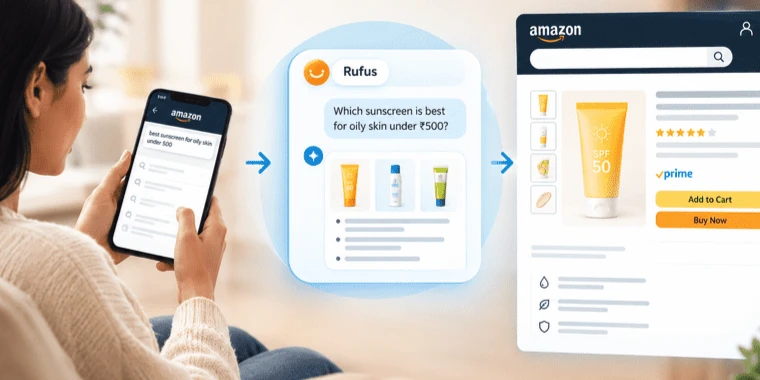
Rufus lets shoppers ask questions in plain language, such as "which sunscreen is best for oily skin under ₹500" or "should I get a fitness band or a smartwatch", and get an answer that may recommend, compare, or summarise products. It launched in the US in early 2024 and arrived in India in beta later that year. Flipkart has its own assistant too, called Flippi. For brands, what "being found" means is changing.
Queries become questions. Instead of typing "sunscreen oily skin", shoppers ask full questions with context: skin type, budget, use case, and who the product is for. Listings built only around short head keywords may not map cleanly onto those questions.
Comparisons happen before the click. Rufus can compare products and pull out themes from customer reviews. By the time a shopper reaches your page, they may already have formed a view based partly on AI summaries of your content and your reviews.
Your content is read, not just indexed. Amazon describes Rufus as trained on its product catalog and on information from across the web, and it draws on customer reviews and community questions and answers. The substance of your listing and what customers say about it feeds directly into the answers shoppers see.
Be clear about what is known and what is not. Amazon has not published how Rufus decides which products to mention, and there is no guaranteed way to rank in its answers. What is reasonable to assume is that the fundamentals of Amazon SEO stay in play, because Rufus sits alongside search rather than replacing it.
Relevance. Titles, bullets, descriptions, and backend search terms still need to match how shoppers search.
Performance. Sales velocity, conversion rate, and click-through rate still influence where products appear in standard results.
Availability and price. Products that are out of stock or priced out of line struggle in any discovery system.
Reviews. Ratings and review volume affect ranking, and they shape how products are described in AI answers.
Write for use cases and questions. Go beyond keyword lists. State who the product is for, when to use it, what problem it solves, and how it differs from alternatives. A bullet that says "suitable for oily and acne-prone skin, non-comedogenic, SPF 50 PA++++" answers a question. A bullet that says "premium sun protection" does not.
Complete every relevant attribute. Structured fields such as size, material, ingredients, compatibility, and age suitability are easy for AI systems to read and match to specific questions. Blank attributes are missed opportunities.
Keep key information in text, not only in images. Many brands put their strongest claims inside A+ images. Make sure the most important facts also appear as text in bullets, descriptions or text modules, where they are easier to read and interpret.
Treat reviews and Q&A as content. If reviews keep raising the same concern, such as sizing or fragrance, address it clearly in your listing. Answer community questions accurately. These are part of what an assistant summarises.
Stay consistent across the web. Because Rufus can draw on information beyond Amazon, conflicting claims between your listing, your brand website, and other marketplaces create confusion.
Test the questions your shoppers ask. Build a list of 20 to 30 real questions from your category, ask Rufus regularly, and record whether and how your products appear. This isn't a ranking report, but it shows you the direction of travel.
This is part of a wider shift. Shoppers now discover products through AI assistants on marketplaces, in search engines and in tools such as ChatGPT and Perplexity. Traditional marketplace SEO and generative engine optimization are converging into one discipline: making product content clear, complete and trustworthy enough to be chosen by algorithms and assistants alike.
That means specialist Amazon SEO work now has to cover both layers. Paxcom Gen-C, for example, is built to optimize product content at SKU scale for marketplace search as well as for AI-driven discovery.
Rufus does not make Amazon SEO obsolete. It raises the bar. The listings that do well will be the ones that answer real questions clearly, keep their facts complete and consistent, and earn the reviews that assistants summarise.

Customer expectations have changed significantly with the growth of digital communication. People wa
8 October 2026
At a glance
5 October 2026
At a Glance
5 October 2026
Be the first to share your thoughts
No comments yet. Be the first to comment!
Share your thoughts and join the discussion below.

.webp&w=3840&q=75)
.webp&w=3840&q=75)




.webp&w=3840&q=75)
.webp&w=3840&q=75)