* All product/brand names, logos, and trademarks are property of their respective owners.
Stair-related accidents are one of the most common safety issues in industrial and commercial environments. Factories, warehouses, office buildings, shopping centers, and public facilities all experience heavy foot traffic every day. When staircases are not properly protected, they can quickly become high-risk zones, leading to slips, trips, and serious injuries. Wet surfaces, worn stair edges, poor visibility, and constant use only increase the chances of accidents.
In industrial settings, safety is not just a recommendation—it is a requirement. Employers and building managers are responsible for providing a safe environment for workers, visitors, and the public. Even a minor slip on a staircase can result in lost workdays, compensation claims, or long-term injuries. That’s why stair safety accessories play such a critical role in overall workplace safety planning.
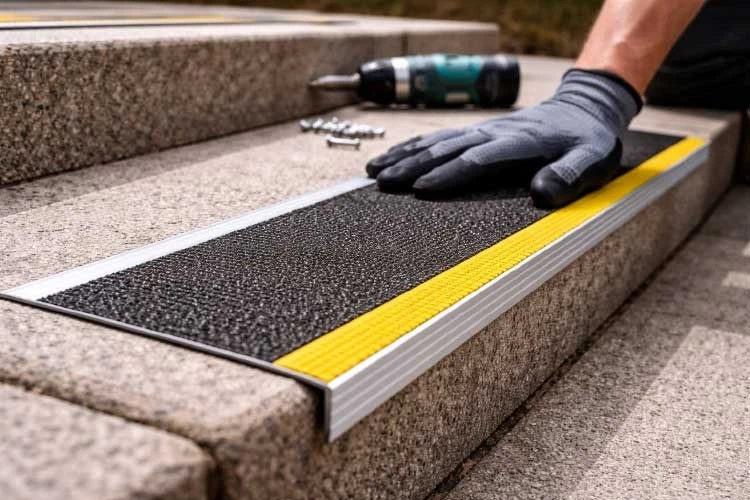
Anti-slip stair nosing is one of the most effective and practical solutions used across industrial and commercial spaces. Installed on the edge of stair treads, it improves grip, enhances visibility, and protects stair edges from wear and damage. More importantly, it acts as a preventive safety measure, helping reduce the risk of accidents before they happen.
Unlike temporary fixes, stair nosing is designed to withstand heavy use and harsh conditions often found in industrial environments. When selected and installed correctly, it becomes a long-term safety investment rather than a short-term solution. Understanding how anti-slip stair nosing works, where it should be used, and how to maintain it can make a significant difference in accident prevention.
Industrial and commercial buildings are exposed to conditions that make staircases particularly hazardous. Unlike residential stairs, industrial stairs face constant foot traffic, equipment movement, dust buildup, moisture, and sometimes oil or chemical residue. Over time, these factors increase the risk of slips, trips, and falls—especially on unprotected stair edges.
One of the most common issues is worn stair nosing edges. Continuous use causes stair edges to smooth out, reducing grip and making it harder for users to place their feet securely. Poor lighting in warehouses or service areas further increases the danger, as people may not clearly see the stair edges while moving quickly or carrying loads.
In workplaces such as factories, hospitals, shopping centres, and office blocks, staircases are shared by employees, visitors, and maintenance staff. This mix of users increases liability risks if safety measures are not in place. For this reason, safety managers often prioritise stair protection as part of their industrial safety planning.
Anti-slip stair nosing plays a critical role in reducing stair-related accidents by addressing multiple safety concerns at once. First, it provides enhanced grip at the most vulnerable part of the stair—the edge. Slip-resistant inserts or textured surfaces help prevent foot slippage, even in wet or dusty conditions.
Second, stair nosing improves edge visibility. Many industrial stair nosing solutions include contrasting colours or defined profiles, making each step easier to see. This is especially important in fast-paced environments where workers may be moving quickly between floors.
Another key benefit is edge protection. By covering the stair edge, anti-slip stair nosing prevents chipping, cracking, and long-term structural damage. This not only improves safety but also reduces maintenance costs and prolongs the life of staircases.
Industrial facilities often rely on dedicated safety solutions such as anti-slip stair nosing systems that are designed specifically for heavy-duty use and compliance with workplace safety standards. These systems are commonly used as part of broader industrial safety strategies, helping organisations meet safety regulations while protecting people from avoidable accidents.
In industrial environments, stair nosing is not just an add-on—it is a core industrial safety accessory. It works alongside handrails, floor markings, and warning signage to create a safer movement system within buildings. When chosen correctly, stair nosing helps organisations meet safety regulations while reducing the likelihood of workplace accidents.
Industrial stair nosing must be strong enough to handle heavy foot traffic, trolleys, and constant use without losing its slip-resistant properties. This is why many facilities rely on suppliers that specialise in industrial-grade stair safety products. For example, platforms like Commercial Stair Nosing provide stair nosing solutions designed specifically for demanding commercial and industrial applications, where durability and compliance are critical.
Different industrial environments require different stair nosing profiles and materials. Selecting the right type depends on traffic levels, location, and safety requirements. Many industrial facilities choose from a range of anti-slip stair nosing options that offer both protection and performance in high-risk areas.
Commonly used industrial stair nosing types include:
Aluminium Stair Nosing – Ideal for heavy-duty industrial and commercial environments where strength and long-term durability are required.
Aluminium Wood Effect Stair Nosing – Offers industrial-grade safety while maintaining a visually consistent finish in offices or public-facing areas.
UPVC Stair Nosing – Lightweight and practical for indoor industrial spaces with moderate foot traffic.
Bullnose Stair Nosing – Features a rounded edge, commonly used in public buildings to reduce impact injuries and improve edge visibility.
These product types are often grouped under dedicated Anti-Slip Stair Nosing categories, making it easier for safety managers and contractors to select suitable solutions based on specific industrial needs.
Even the highest-quality anti-slip stair nosing can fail if it is not installed correctly. In industrial environments, improper installation often leads to loose edges, uneven surfaces, or reduced grip—creating new hazards instead of solving existing ones.
Alignment also matters. Stair nosing should sit flush with the stair edge without gaps or raised sections. Poor alignment can cause footwear issues, increasing the risk of trips. In high-traffic areas, professional installation is often recommended to ensure long-term performance and compliance with workplace safety standards.
Maintenance is a key part of keeping stair nosing effective over time. Industrial settings experience constant use, and even slip-resistant surfaces can wear down if not regularly inspected. Routine checks help identify loose fixings, worn inserts, or surface damage before accidents occur. If stair nosing shows signs of excessive wear or damage, replacement should be done promptly.
Anti-slip stair nosing plays a vital role in improving safety across industrial and commercial environments. From factories and warehouses to offices and public buildings, stairs remain one of the most common locations for slips and falls. Without proper edge protection and grip, these areas pose ongoing risks to workers, visitors, and building occupants.
As an industrial accessory, stair nosing offers multiple benefits in a single solution. It enhances slip resistance, improves stair edge visibility, and protects stair structures from long-term wear. When combined with correct installation and regular maintenance, it becomes a reliable, long-term safety measure rather than a temporary fix.
Selecting the right type of stair nosing based on traffic levels, surface material, and usage conditions is essential for achieving effective results. By prioritising stair safety, industrial facilities can significantly reduce accidents, support compliance with safety standards, and create safer environments for everyone who uses their buildings.

We are a UK-based supplier of stair nosing, wall corner protection, door thresholds, skirting boards, and interior finishing profiles for commercial and residential projects. We provide durable, safety-focused solutions for high-traffic environments, supplying quality products to contractors, architects, and property professionals across the UK.
The industrial diesel engine is commonly found in construction equipment, generators, agricultural e
18 August 2026
Workplace safety has come a long way over the past few decades, and one area that has seen major imp
18 August 2026
When you walk into any major concert event today, the first thing that hits you is the visuals. You
11 August 2026
Be the first to share your thoughts
No comments yet. Be the first to comment!
Share your thoughts and join the discussion below.
.webp&w=3840&q=75)








.webp&w=3840&q=75)
.webp&w=3840&q=75)